Tuesday, September 23, 2008

092608

Am working backwards this week using my images as the starting point. This was definitely a month of jolting into a rude but necessary awareness, and it has been a bumpy rough ride that at least has slowed down without quite coming to a stop. Funny that significant change and shakeup is also occurring in the outside world. Although somewhat destructive on some level, also realizing that realism may be a more constructive way of looking at my relationships going forward, but the familiar is looking a little odd these days; the same but not the same:


Although I've personalized and have taken this out of its larger feminist context, this work by Kirsten Justesen, "Sculpture II", a part of Wack! that originated at LACMA and showed at PS1 pretty much sums up how I've been feeling lately; social confusion and isolation, unwelcomed containment or restriction, an unfamiliar desire to remain hidden, being seen without really being seen; however, on second thought, this largely stems from interactions with various men in my life in reaction to their varying and usually hidden levels of traditional male thinking, whether at work or in my personal life, whether I've known them for decades or more recently:

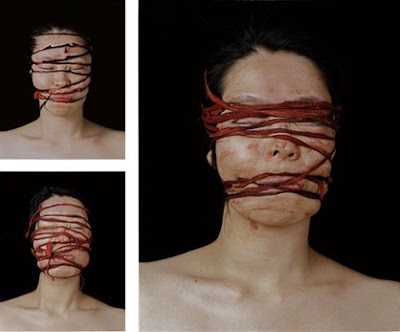
These particularly painful and brutal images by Ryoko Suzuki "Bind," that appeared in the Brooklyn Museum, seems to speak to how women can feel tied up and bound, barely or not able to speak, much less be heard, in the face of outmoded historical chauvinistic views that are taking a long time (maybe not in the history of mankind, but in the generations of women and men since the social upheaval of the 1960s) to fundamentally change into an automatic part of modern social relationships:

Can't give the artist name or title for this image, except that it is part of the "Truthiness, Photography as Sculpture" show at the UC Riverside, California Museum of Photography:

When I saw this deaf-blind-mute-wrapped-enclosed body lost in pastel innocent colors, I thought of my optimism, and therefore reluctance, to label and categorize people, which for the most part has served me well because I remained open, and as a result, enjoy some great relationships. Sometimes, this has not worked out well for the same reason, and I feel mute, at a loss. And there's the interesting position; is she in submission, unable to stand up for herself or merely looking for something?

Wednesday, September 10, 2008

091208

Delving into others' work on window reflections, I'm taking a closer look at Lee Friedlander's work. This image was taken in Colorado (currently in the permanent collection of The Art Institute of Chicago) several years after Robert Kennedy's assassination in 1963. What makes this image interesting is the disconnected halves, right from left, outside looking in, inside looking out, Robert Kennedy's head over another man's head hidden underneath and behind, Robert Kennedy being shot in head; people losing their heads.


Over the summer, I found William Eggleston's photo essay, "Faulkner's Mississippi," which is both photography and narrative about the American southern writer, William Faulkner. The thing that strikes me first about Eggleston's images is the deep vivid saturation that shouts for a closer look:


What appeals is Eggleston's everyday view of things, which is easy to overlook, but somehow grabs your attention for a closer second look..."an extraordinary ability to find beauty in the banal...and in its apparent casualness, it is emblematic of Eggleston's art, being both ordinary and loaded with meaning, utterly simple and yet endlessly complex" as Sean O'Hagen from The Observer put it.

Finding beauty in the banel right off the street is Garry Winogrand:


Being from Los Angeles, I'm going to guess this is Grant Street taken in the late afternoon sometime in the 1960s. Something about it appealed before I knew it was taken in LA; maybe it's a subconcious thing. The women look stylish and the intersection of shadows from their legs and window reflections are wonderful. Then there's the folks waiting for the bus. And the young guy sitting in the wheelchair seems unable to lift his head to look at these beautiful women who are looking at him, which is a bit heartbreaking, but maybe not really; maybe it feels good just be sitting out in the LA sun. Several layers of world all meeting in the one transient moment.

Some of my own recent banel reflection images:

Tuesday, August 26, 2008

090508


What's appealing about window reflections is the psychological element, and depending on the time of day and where one is standing and who or what is passing by, the myriad possibilities of images. Glass is only a surface, but that surface changes, a hard surface with fluid flexibility. In Philip-Lorca diCorcia's "Mike Miller; 24 years old; Allentown, Pennsylvania", the image is taken through glass at someone who appears to be taking a quiet reflective moment and more reflections and layers on the glass surface farthest from the view; like the subject is caught between different depths and perceptions captured at that particular moment in time.

"Capturing daily life in the form of ‘snapshots’ taken in the street," Daido Moriyama “I. Retrospective 1965-2005″ & “II. Hawaii”


Taking street images out of context makes them a little surreal; capturing what is often overlooked because it's just there like so much noise, or a note of a song, but not looked at individually.

Talking about Ansel Adams with a friend the other day, I realized that his work is the exact opposite of mine. He lugged heavy manual equipment up dizzying heights in nature and was maddeningly deliberate and technical in taking his time-consuming grand landscape images shot in black-and-white.


While my color snapshot images are taken from a lightweight hand-held digital camera on flat streets, often close up, and take seconds to find and capture. Yet there is a joy in taking the pleasing image that captures our attention, compelling us to archive it, whatever it may be.

Thursday, August 14, 2008

082208

Came across a couple of sites this week where the photographers make their own cameras, from the rather primitive yet effective cameras by Czech photographer Miroslav Tichy


to the elaborate cameras by "Boy of Blue" artist Wayne Martin Belger


Tichy invented his film cameras out of bits and pieces of trash, while Belger's are highly-developed cameras whose elaborateness are in direct contrast to the simplicity of the pinhole. Both types produce a wonderful dreamy effect with psychological edge and tension. Since Tichy lived behind the iron curtain (so hard to find a camera for sale), do these images have a historical significance or did he simply like naked women? (seems to be quite the leg man).


Facing a light source, the iconic cross looks like its warding off the threatening storm behind it, but what's that plastic angel doing exactly?


Here are a few recent images from my Canon point-and-shoot:


I picked these images because although they're not dreamy, they're a bit edgy (or in the case of jack fruit image, pointy). The man's bruised face and torn eyes, the scattering of neon light; things seem displaced or disrupted, forcing our gaze, sometimes on the surface, other times disturbingly inward.